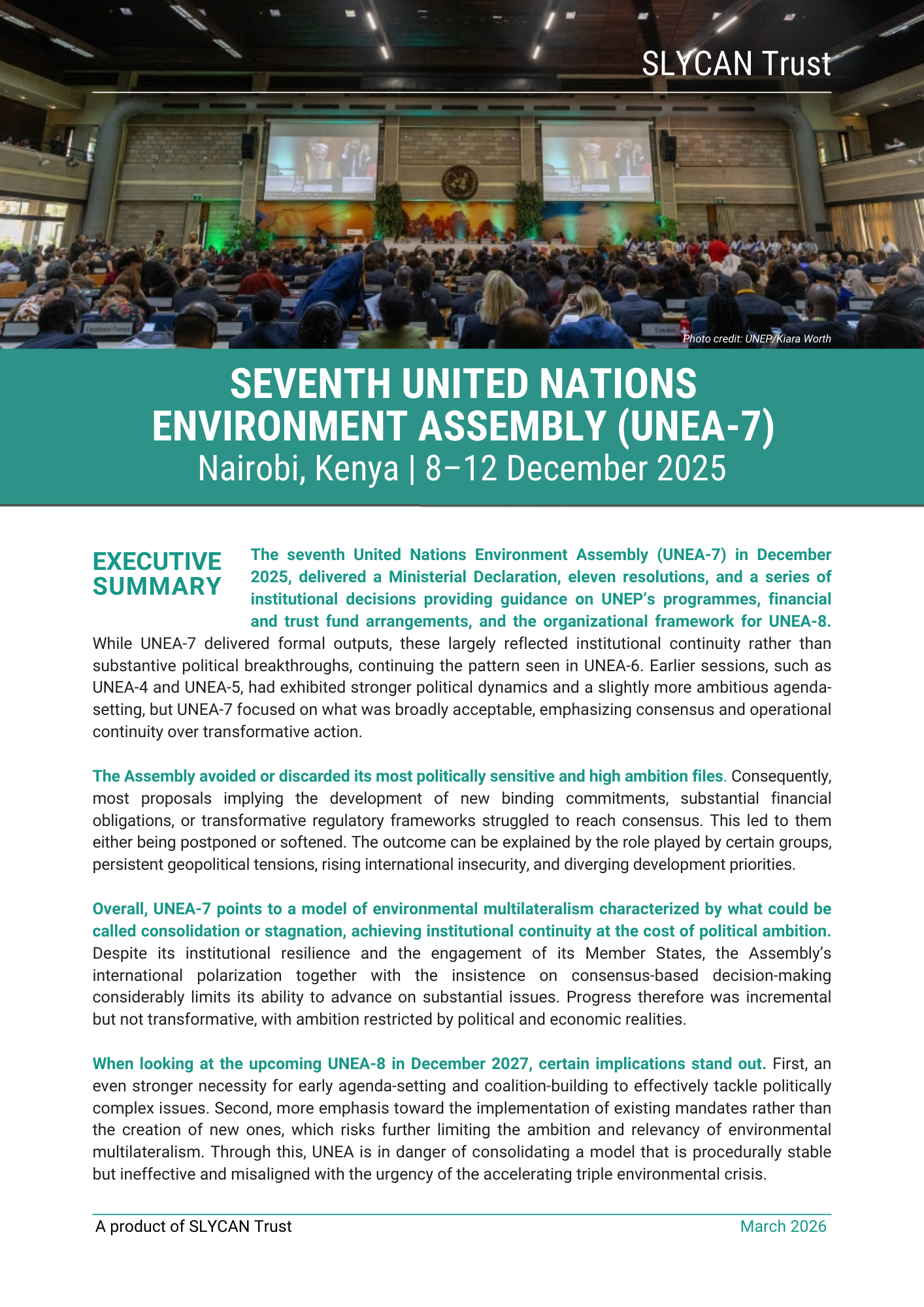
The seventh United Nations Environment Assembly (UNEA-7) in December 2025, delivered a Ministerial Declaration, eleven resolutions, and a series of institutional decisions providing guidance on UNEP’s programmes, financial and trust fund arrangements, and the organizational framework for UNEA-8.
While UNEA‑7 delivered formal outputs, these largely reflected institutional continuity rather than substantive political breakthroughs, continuing the pattern seen in UNEA‑6. Earlier sessions, such as UNEA‑4 and UNEA‑5, had exhibited stronger political dynamics and a slightly more ambitious agenda-setting, but UNEA‑7 focused on what was broadly acceptable, emphasizing consensus and operational continuity over transformative action.
The Assembly avoided or discarded its most politically sensitive and high ambition files. Consequently, most proposals implying the development of new binding commitments, substantial financial obligations, or transformative regulatory frameworks struggled to reach consensus. This led to them either being postponed or softened. The outcome can be explained by the role played by certain groups, persistent geopolitical tensions, rising international insecurity, and diverging development priorities.
Overall, UNEA-7 points to a model of environmental multilateralism characterized by what could be called consolidation or stagnation, achieving institutional continuity at the cost of political ambition. Despite its institutional resilience and the engagement of its Member States, the Assembly’s international polarization together with the insistence on consensus-based decision-making considerably limits its ability to advance on substantial issues. Progress therefore was incremental but not transformative, with ambition restricted by political and economic realities.
When looking at the upcoming UNEA-8 in December 2027, certain implications stand out. First, an even stronger necessity for early agenda-setting and coalition-building to effectively tackle politically complex issues. Second, more emphasis toward the implementation of existing mandates rather than the creation of new ones, which risks further limiting the ambition and relevancy of environmental multilateralism. Through this, UNEA is in danger of consolidating a model that is procedurally stable but ineffective and misaligned with the urgency of the accelerating triple environmental crisis.
This breifing note developed by SLYCAN Trust disects the outcome from UNEA-7.